KBC Petro-SIM and SIM Reactor Suite 7.6 – Process Simulation Software Download
KBC Petro-SIM and the SIM Reactor Suite are advanced engineering software solutions for process simulation, refinery modeling, reactor simulation, and process optimization. The platform is designed for engineers and technical teams working with oil and gas processing, petroleum refining, petrochemicals, and other complex process industries.
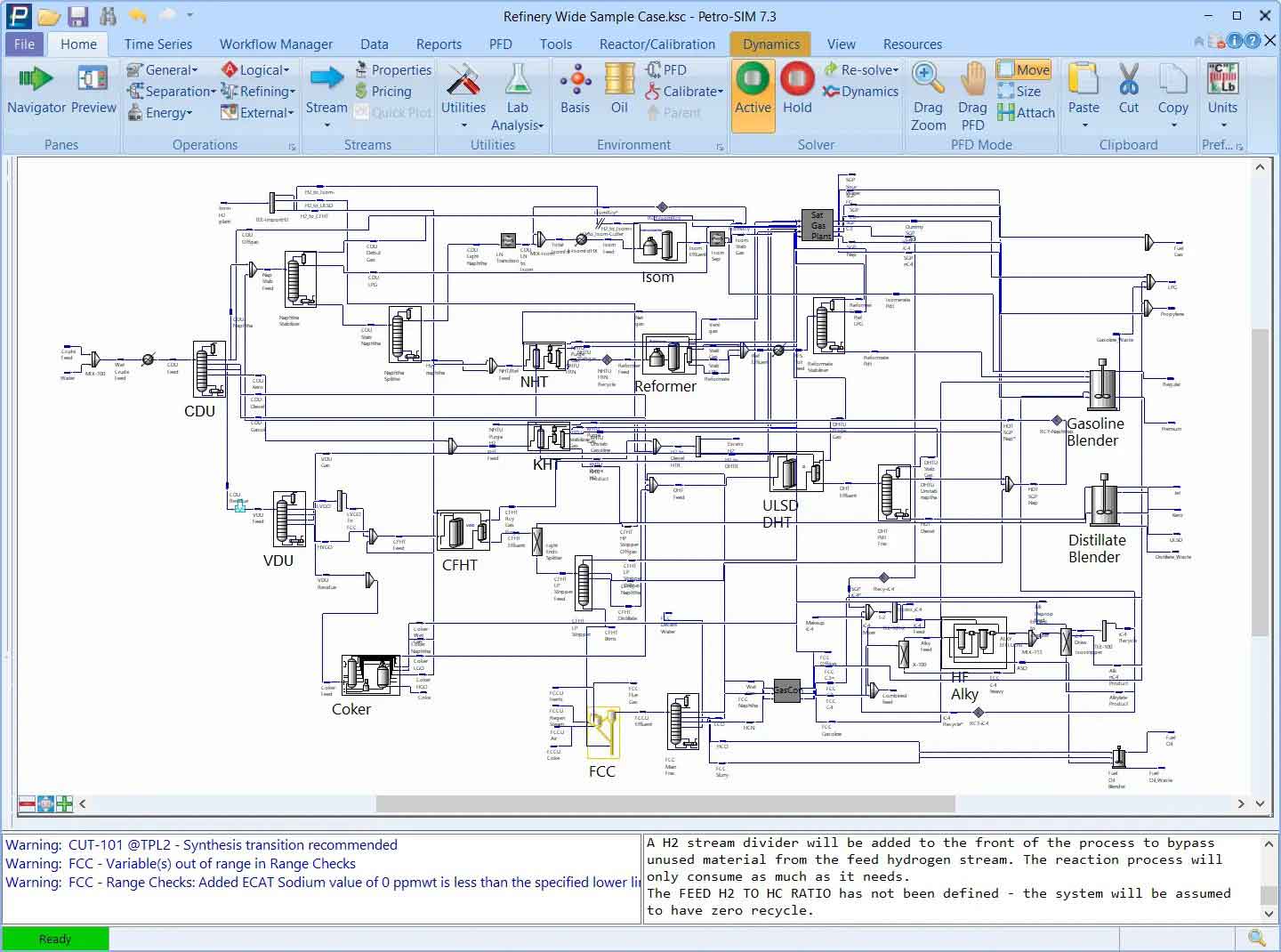
Petro-SIM provides a high-fidelity process simulation environment, while the SIM Reactor Suite adds specialized kinetic reactor models for refinery and petrochemical process units. Together, they can be used to build detailed models ranging from individual process units to integrated refinery-wide configurations.
What Is KBC Petro-SIM?
Petro-SIM is KBC’s process simulation platform for modeling and optimizing oil and gas, refining, petrochemical, and related process operations.
The software can model individual process units or combine multiple units into larger facility-wide simulations. This allows engineers to investigate how changes in feedstocks, operating conditions, equipment constraints, and product requirements can affect overall plant performance.
Petro-SIM is also used in applications involving process optimization, digital twins, operator training, real-time optimization, and decarbonization studies.
What Is the SIM Reactor Suite?
The SIM Reactor Suite is a collection of detailed reactor models developed for refinery and petrochemical applications.
Unlike a general-purpose process simulator that may use simplified reactor representations, the Reactor Suite provides specialized kinetic models for individual process units.
The models incorporate detailed reaction behavior and can account for factors such as catalyst activity, feed contaminants, catalyst deactivation, operating conditions, product yields, and process constraints.
KBC states that the reactor models can be used independently or within the Petro-SIM flowsheet environment.
Petro-SIM and Reactor Suite Working Together
The combination of Petro-SIM and the Reactor Suite allows engineers to build more detailed refinery and petrochemical models.
Petro-SIM provides the overall process flowsheet, thermodynamic environment, streams, equipment, and process relationships, while specialized Reactor Suite models can represent important conversion units with more rigorous kinetic behavior.
This approach can be useful when analyzing the interaction between feed quality, reactor performance, fractionation, product properties, and downstream operations.
KBC describes this capability as refinery-wide flowsheeting, where individual conversion units can be modeled rigorously and integrated into a larger refinery configuration.
Refinery Process Simulation
One of the main applications of Petro-SIM is refinery process simulation.
Engineers can use the platform to represent refinery configurations from crude feed processing through conversion units, separation, product treatment, and blending.
A refinery-wide model can help evaluate:
- Feedstock alternatives
- Operating conditions
- Unit constraints
- Product yields
- Product quality
- Energy consumption
- Hydrogen usage
- Catalyst performance
- Product blending
- Refinery profitability
- Potential process improvements
KBC reports that it has developed refinery-wide Petro-SIM flowsheets for more than 130 refineries as part of process integration studies.
Reactor Modeling
The SIM Reactor Suite contains specialized models for different refinery and petrochemical applications.
These models are based on detailed process and reaction representations and can be used to evaluate reactor performance under different operating conditions.
Examples include models for:
- Delayed coking
- Hydrocracking
- Diesel hydrotreating
- Fluid catalytic cracking
- Naphtha hydrotreating
- Cracked naphtha hydrotreating
- Residue hydrocracking
- Catalytic reforming
- Aromatics processing
- Isomerization
- Vacuum gas oil hydrotreating
- Residue hydrotreating
- Alkylation
- Visbreaking
The available model portfolio is intended to cover a broad range of refinery conversion and treating processes.
DC-SIM for Delayed Coking
DC-SIM is KBC’s kinetic simulation model for delayed coking units.
It provides detailed models for key parts of a delayed coker, including the furnace, coke drums, and fractionation tower.
Engineers can use DC-SIM to investigate:
- Mass and energy balances
- Feedstock effects
- Coker yields
- Product quality
- Coke drum temperatures
- Recycle rates
- Furnace operation
- Coker optimization
The model can also be used to evaluate alternative operating strategies and monitor daily unit performance.
HCR-SIM for Hydrocracking
HCR-SIM is a first-principles kinetic model for hydrocracking applications.
The model can represent different hydrocracker configurations, including single-stage, multi-stage, and separate-stage arrangements.
It supports different catalyst beds, catalyst types, hydrogen makeup locations, separators, and product configurations.
This allows engineers to evaluate hydrocracker performance under different feedstocks and operating scenarios.
D HTR-SIM for Diesel Hydrotreating
D HTR-SIM provides detailed kinetic modeling for diesel hydrotreating.
The model covers important reactions such as:
- Hydrodesulfurization
- Hydrodenitrogenation
- Olefin saturation
- Aromatic saturation
- Naphthene ring opening
- Cracking
It also accounts for catalyst deactivation caused by feed contaminants and metals.
KBC has also added a renewable mode to D HTR-SIM for modeling the hydrotreatment of renewable feedstocks such as plant and animal oils. The model can evaluate co-processing and dedicated bio-oil processing scenarios.
FCC-SIM for Fluid Catalytic Cracking
FCC-SIM is KBC’s first-principles kinetic simulation model for fluid catalytic cracking units.
It models the reactor and regenerator system and can also represent key downstream sections of the FCC process.
The model can be used to investigate different feedstocks, operating conditions, catalyst characteristics, yields, and product properties.
KBC also provides catalyst database functionality that can be used to compare potential catalyst changes and evaluate their effect on FCC performance.
N HTR-SIM for Naphtha Hydrotreating
N HTR-SIM provides detailed simulation of naphtha hydrotreating reactors combined with product separation.
The model includes important hydrotreating reactions and can account for catalyst deactivation caused by feed contaminants.
It can therefore be used to study process performance and product quality under different operating and feed conditions.
REF-SIM for Catalytic Reforming
REF-SIM is a detailed kinetic model for catalytic reforming.
It can represent both the reaction and separation sections of a reforming process and supports several commercial reformer configurations.
The model can be used for process analysis, optimization, and evaluation of different feed and operating scenarios.
AROM-SIM for Aromatics Processing
AROM-SIM is designed for modeling aromatics processing facilities.
It combines key reaction systems such as xylene isomerization and transalkylation into a single modeling environment.
The software can be used for optimization, planning, monitoring, and design studies involving aromatics processing units.
ISOM-SIM for Isomerization
ISOM-SIM is used to model gasoline isomerization processes.
It can represent isomerization of C4 streams as well as C5/C6 light naphtha processes used to improve octane.
The model can help engineers investigate the relationship between feed composition, catalyst behavior, operating conditions, and product quality.
VGO HTR-SIM
VGO HTR-SIM provides rigorous kinetic simulation of vacuum gas oil hydrotreating.
The model combines reactor kinetics with product separation and can be used to evaluate feed effects, catalyst deactivation, run length, yield vectors, and operating conditions.
This makes it useful for both operational analysis and longer-term refinery planning.
RHDS-SIM
RHDS-SIM is designed for residual hydrotreating applications.
It combines detailed reactor kinetics with product separation and includes modeling of metal deposition on catalysts and the resulting effect on catalyst performance.
The model can be used to investigate run length, catalyst deac
Price : 20$
Email : royalprog.contact@gmail.com
WhatsApp : +19084456316